Luoyang Anjing Intelligence Equipment are a global leader in high-temperature electric furnaces



How to Choose the Right Furnace Size and Chamber Capacity
When selecting furnace dimensions and chamber capacity, you must consider the maximum size of the workpieces, the weight per batch, the loading method, the operating temperature, production requirements, and the necessary clearance around the workpieces. The furnace chamber should be large enough to ensure uniform heating, but there is no need to make it excessively large.
I.Introduction
How to choose the right furnace size and chamber capacity is one of the most important decisions when purchasing an industrial or laboratory electric furnace. A chamber that is too small can restrict loading, reduce temperature uniformity, and limit future production. A furnace that is unnecessarily large may increase equipment cost, power requirements, heat-up time, and energy consumption.
The correct furnace chamber size should therefore be based on your workpiece dimensions, batch weight, loading arrangement, operating temperature, heating process, and required production capacity. This guide explains how to calculate furnace size step by step and highlights common sizing mistakes to avoid before purchasing a furnace.
II. What Does Furnace Size Mean?
When comparing electric furnaces, “furnace size” can refer to several different specifications.
The most important are:
- External furnace dimensions
- Internal chamber dimensions
- Effective working-zone dimensions
- Chamber volume
- Maximum loading capacity
- Maximum batch weight
- Furnace power
- Production capacity
These specifications are related, but they are not interchangeable.
For furnace selection, the most important parameter is usually the usable working zone, because this determines whether your workpieces can be heated correctly.
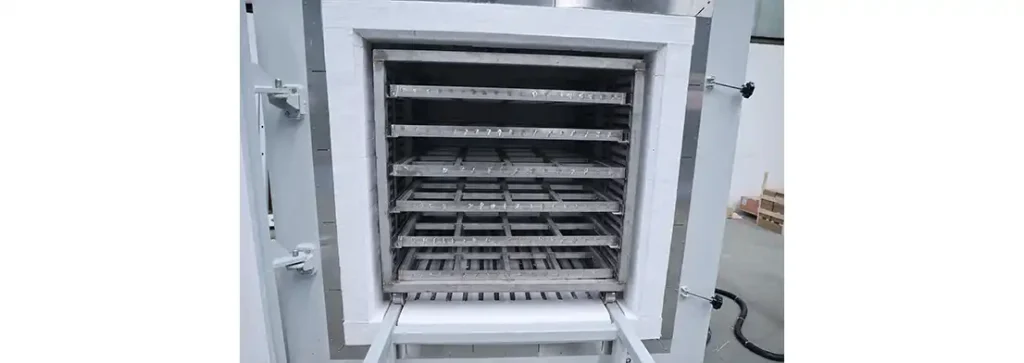
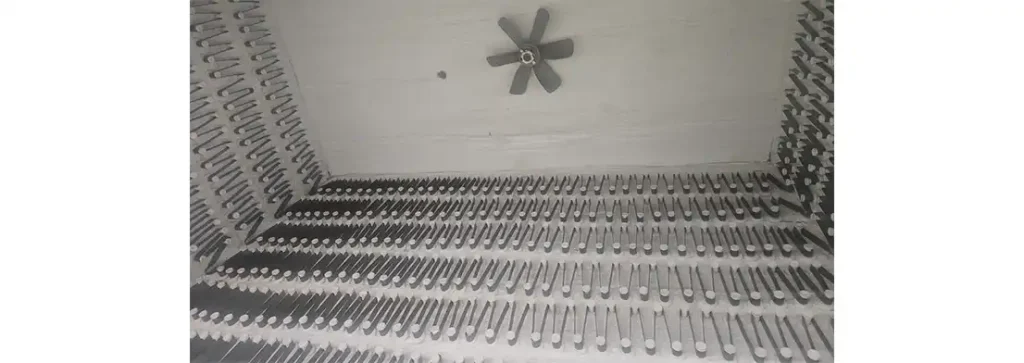
While the internal volume of a furnace may be quite large, the actual usable working space is often smaller, as room must be allocated for heating elements, thermal insulation, requirements for temperature uniformity, fixtures, and the necessary clearance around the workpieces.
Therefore, do not choose a furnace based only on its advertised chamber volume.
Step 1: Measure Your Maximum Workpiece Dimensions
Start by identifying the largest workpiece you expect to process.
Measure:Length × Width × Height
For example, suppose your maximum workpiece measures:600 × 400 × 300 mm
You should not automatically select a furnace with an internal chamber of exactly:600 × 400 × 300 mm
The workpiece needs additional clearance for:
- Loading and unloading
- Thermal expansion
- Fixtures and trays
- Heat circulation
- Radiation from heating elements
- Temperature uniformity
- Safe separation from furnace components
The furnace chamber must therefore be larger than the workpiece itself.

Step 2: Include Fixtures, Trays, and Loading Equipment
One of the most common furnace-sizing mistakes is measuring only the product.
In actual production, the furnace may also contain:
- Loading trays
- Baskets
- Racks
- Crucibles
- Boats
- Saggers
- Molds
- Supports
- Fixtures
These components consume usable chamber space.
For example:
Workpiece: 500 × 400 × 300 mm
Fixture: adds 100 mm to the total width and height
The actual loaded dimensions may become:500 × 500 × 400 mm
The furnace should therefore be selected according to the complete loaded assembly, not the bare workpiece.
Step 3: Add Clearance Around the Load
Do not fill the entire furnace chamber with workpieces.
Adequate space should normally be maintained between:
- Workpiece and chamber wall
- Workpiece and heating elements
- Workpiece and furnace roof
- Individual workpieces
- Workpiece and temperature sensors
Why?Because heat must reach the load uniformly.
If workpieces are packed too tightly, some areas can heat more slowly than others, creating:
- Hot spots
- Cold spots
- Longer heating cycles
- Uneven heat treatment
- Inconsistent product quality
There is no universal clearance value suitable for every furnace.
The required clearance depends on:
- Heating method
- Furnace temperature
- Heating-element arrangement
- Air or atmosphere circulation
- Workpiece material
- Load density
- Required temperature uniformity
Ask the furnace manufacturer for the recommended usable working zone, rather than assuming the entire chamber can be filled.
Step 4: Calculate Furnace Chamber Volume
For a rectangular chamber, the basic internal volume is:Chamber Volume = Length × Width × Height
For example:800 mm × 600 mm × 500 mm
Convert to meters:0.8 × 0.6 × 0.5 = 0.24 m³
Therefore, the chamber volume is:0.24 cubic meters
However, chamber volume alone cannot determine furnace capacity.
Two loads may occupy the same volume but have completely different weights.
For example:
- Steel components
- Ceramic powder
- Graphite products
- Lightweight insulation
- Aluminum components
all have different mass and thermal characteristics.
Therefore, both volume and weight must be considered.
Step 5: Calculate the Required Batch Weight
Next, determine how much material you need to process per batch.
Suppose your production requirement is:1,000 kg/day
and you plan to operate:5 batches/day
Then:Required batch capacity = 1,000 ÷ 5
= 200 kg/batch
The furnace should therefore be capable of processing at least approximately 200 kg per batch, subject to the manufacturer’s load and process limits.
But this does not mean that any chamber physically capable of holding 200 kg is suitable.
The heating system must also have sufficient power to heat the load within the required cycle time.
Step 6: Consider the Thermal Mass of the Load
The furnace does not only heat the chamber.
It must heat:Workpieces + fixtures + trays + furnace atmosphere + process accessories
A heavy steel load requires substantially more energy than a lightweight laboratory sample.
The basic sensible-heat relationship is:Q = m × Cp × ΔT
Where:
- Q = required heat energy
- m = mass of the load
- Cp = specific heat capacity
- ΔT = required temperature increase
In real furnace operation, additional energy is needed because of:
- Furnace-wall heat storage
- Door-opening losses
- Radiation losses
- Exhaust losses
- Cooling-water losses where applicable
- Process atmosphere losses
- Equipment efficiency
Therefore, chamber dimensions and furnace power should be selected together.
Step 7: Determine Your Required Operating Temperature
Furnace chamber size cannot be separated from temperature.
A furnace designed for 500°C and a furnace designed for 1700°C may have very different:
- Insulation thickness
- Heating elements
- Chamber materials
- Power requirements
- Heating layouts
- Usable working zones
Common electric furnace temperature classes may include:
- 500°C
- 800°C
- 1000°C
- 1200°C
- 1400°C
- 1600°C
- 1700°C
- 1800°C or higher
As operating temperature increases, furnace design becomes more demanding.
Therefore, when requesting a furnace quotation, always provide:Required working temperature + maximum temperature
Do not specify chamber dimensions alone.
Step 8: Define the Required Temperature Uniformity
Temperature uniformity is especially important for:
- Heat treatment
- Annealing
- Tempering
- Sintering
- Ceramics
- Powder metallurgy
- Electronic materials
- Laboratory testing
The entire physical chamber is not necessarily the certified or effective uniform-temperature zone.
For example, areas close to:
- Furnace doors
- Heating elements
- Corners
- Exhaust openings
may behave differently from the center of the chamber.
If your product requires strict temperature uniformity, ask the manufacturer to specify:
- Effective working-zone dimensions
- Temperature uniformity
- Number of heating zones
- Thermocouple locations
- Heating-element arrangement
- Temperature-control accuracy
This information is more meaningful than chamber volume alone.
Step 9: Determine the Loading Method
How the furnace is loaded can significantly affect the required chamber dimensions.
Front-Loading Furnace
Suitable for:
- General heat treatment
- Laboratory applications
- Small and medium workpieces
- Tray loading
The chamber must provide enough space for convenient loading through the furnace door.
Top-Loading Furnace
Suitable for certain:
- Crucibles
- Vertical workpieces
- Heavy loads
- Specialized processes
Bottom-Loading Furnace
Useful for:
- Large components
- Heavy workpieces
- High-temperature applications
- Products requiring easier loading
Pit or Vertical Furnace
Suitable for long workpieces such as:
- Shafts
- Rods
- Tubes
- Long tools
A long vertical component may require a pit furnace rather than an extremely deep horizontal chamber.
Therefore, the shape of the workpiece can be just as important as its volume.
Step 10: Calculate Production Capacity
For industrial furnaces, chamber size should ultimately support your production target.
A simplified relationship is:Daily Production Capacity = Batch Load × Number of Batches per Day
Suppose:Batch load = 300 kg
and:6 batches/day
Then:300 × 6 = 1,800 kg/day
or:1.8 tons/day
However, the number of batches depends on the complete cycle time.
Step 11: Calculate the Complete Furnace Cycle
Do not calculate production using heating time alone.
A complete furnace cycle may include:
- Loading
- Initial heating
- Temperature ramp
- Holding/soaking
- Process-at-temperature time
- Controlled cooling
- Unloading
- Preparation for the next batch
For example:
| Process | Time |
|---|---|
| Loading | 15 min |
| Heating | 90 min |
| Holding | 60 min |
| Cooling | 90 min |
| Unloading | 15 min |
| Total | 270 min |
The complete cycle is:270 minutes = 4.5 hours
If the furnace operates for 18 hours per day:18 ÷ 4.5 = 4 batches/day
If each batch is 300 kg:300 × 4 = 1,200 kg/day
Therefore, the practical production capacity is approximately:1.2 tons/day
This calculation is much more useful than simply saying that the furnace chamber can hold 300 kg.
Step 12: Decide Whether You Need One Large Furnace or Multiple Smaller Furnaces
Suppose your total required capacity is:600 kg per production cycle
You may consider:Option A: One 600 kg furnaceor:Option B: Two 300 kg furnaces
One larger furnace may provide:
- Simpler operation
- Fewer control systems
- Fewer furnace doors
- Potentially lower equipment complexity
Multiple smaller furnaces may provide:
- Greater production flexibility
- Easier product changes
- Easier maintenance scheduling
- Partial production during maintenance
- Different temperature programs simultaneously
The best arrangement depends on your production flow.
Step 13: Consider Future Production Requirements
Do not size a furnace exclusively around today’s largest workpiece if your production is likely to change.
Before purchasing, consider:
- Future workpiece dimensions
- Production growth
- New materials
- Higher temperature requirements
- Larger batch sizes
- Additional product lines
Some reserve capacity can be useful.
However, this does not mean you should purchase the largest furnace your budget allows.
The goal is reasonable expansion capability, not unnecessary oversizing.
How Much Larger Should the Furnace Chamber Be Than the Workpiece?
There is no universal percentage.
The required chamber clearance depends on the furnace design and process.
For preliminary planning, consider:Maximum loaded dimensions + required thermal clearance + loading clearance
Do not use a fixed rule such as “make the chamber 20% larger” for every application.
A dense steel heat-treatment load and a lightweight ceramic laboratory load may require very different arrangements.
The furnace manufacturer should verify the final usable working zone.
Chamber Volume vs. Load Capacity: What Is the Difference?
This distinction is important when comparing furnace quotations.
| Specification | What It Tells You |
|---|---|
| Chamber dimensions | Physical internal space |
| Chamber volume | Total geometric volume |
| Effective working zone | Recommended usable heating area |
| Maximum load weight | Structural/load limitation |
| Batch capacity | Practical process load |
| Furnace power | Available heating input |
| Cycle time | Time required per production batch |
| Production capacity | Practical output over time |
A supplier quoting only chamber dimensions has not necessarily demonstrated that the furnace can meet your production requirements.
III. Furnace Chamber Size Example
Suppose a customer needs to heat-treat steel parts with the following specifications:
Maximum part dimensions:600 × 400 × 300 mm
Fixture dimensions:700 × 500 × 400 mm
Batch weight:250 kg
Working temperature:950°C
Required production:1,000 kg/day
Available production time:16 hours/day
The first calculation is:1,000 ÷ 250 = 4 batches/day
Maximum available cycle time:16 ÷ 4 = 4 hours/batch
The furnace therefore needs to satisfy both:
Physical Requirement
The effective working zone must accommodate the complete:700 × 500 × 400 mm fixture/load assembly
with appropriate clearance.
Thermal Requirement
The heating system must bring approximately 250 kg plus fixtures to the required temperature within the available cycle.
Therefore, simply purchasing a furnace advertised as having a 700 × 500 × 400 mm chamber would be risky.
The manufacturer should calculate:
- Required chamber dimensions
- Effective working zone
- Heating power
- Heating zones
- Temperature uniformity
- Cycle time
based on the actual load.
IV.Conclusion
To choose the right furnace size and chamber capacity, start with the complete loaded dimensions—not the bare workpiece. Then consider batch weight, fixtures, required clearance, operating temperature, temperature uniformity, heating power, cycle time, and daily production target. A larger chamber is not automatically better: an oversized furnace may increase capital cost, power requirements, heat-up time, and thermal losses, while an undersized furnace can restrict loading and production.
For an accurate furnace recommendation, provide your workpiece dimensions, batch weight, operating temperature, fixture size, atmosphere, and required production per day. These parameters allow the furnace manufacturer to determine the appropriate chamber dimensions, working zone, heating power, and furnace configuration.
Click “Request a Quote” to get a customized solution.
V. FAQ
1. How do I calculate the right furnace chamber size?
First, measure the overall maximum dimensions of the workpiece, including its fixture; then, allow for additional space for loading, heating, thermal expansion, and ensuring uniform temperature distribution.
2. How much bigger should a furnace be than the workpiece?
There is no fixed ratio. The amount of clearance to leave depends on the shape of the workpiece, temperature, the arrangement of heating elements, atmosphere circulation, loading density, and requirements for temperature uniformity.
3. What is the difference between furnace chamber volume and capacity?
Furnace volume refers to the actual internal space of the furnace; production capacity may refer to the maximum load weight, the capacity per batch, or the actual output.
4. How do I calculate furnace production capacity?
For a batch furnace, a rough calculation can be made as follows: Daily Output = Weight per Batch × Number of Batches per Day.
The number of batches per day must be determined based on the complete cycle, which includes loading, heating, holding (soaking), cooling, and unloading.
5. Can furnace chamber dimensions be customized?
Yes. Many industrial furnaces and laboratory electric furnaces can be customized based on factors such as workpiece dimensions, batch weight, temperature, loading method, and specific production requirements. Custom sizing is particularly useful when workpieces are long, heavy, irregularly shaped, or subject to special requirements.
Supplier
Luoyang Anjing Intelligent Equipment Co., Ltd. is an enterprise dedicated to the research, development, production, sales, and technical services of heat treatment equipment such as high-temperature electric furnaces. We produce laboratory, vacuum, industrial, and medium frequency furnace, covering a temperature range from -100℃ to 2600℃, serving industries such as new energy, semiconductors, and advanced materials. We can provide customized solutions based on specific atmosphere, ultra-high temperature, and intelligent control system requirements. Please feel free to contact us if you are interested.