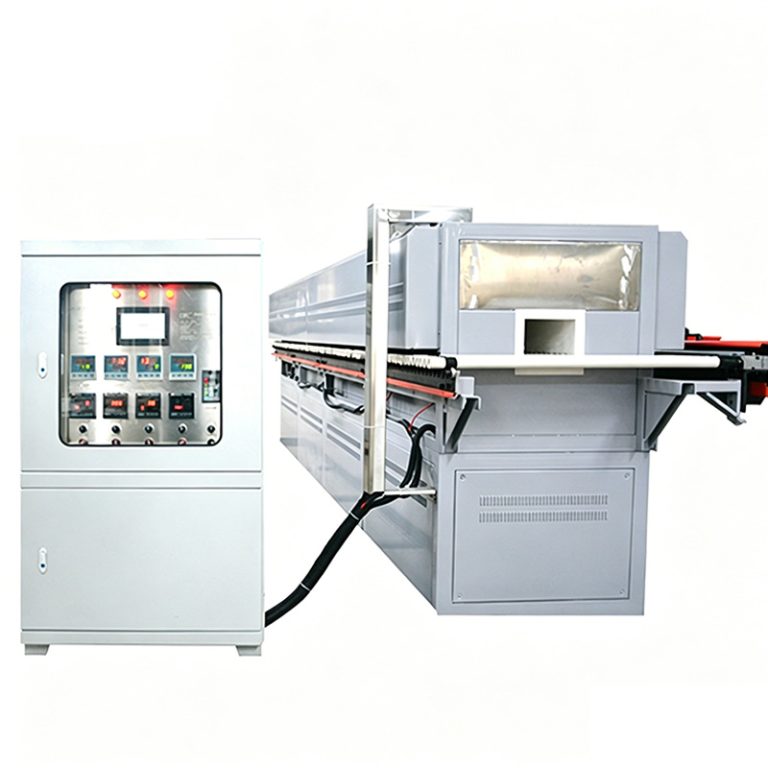
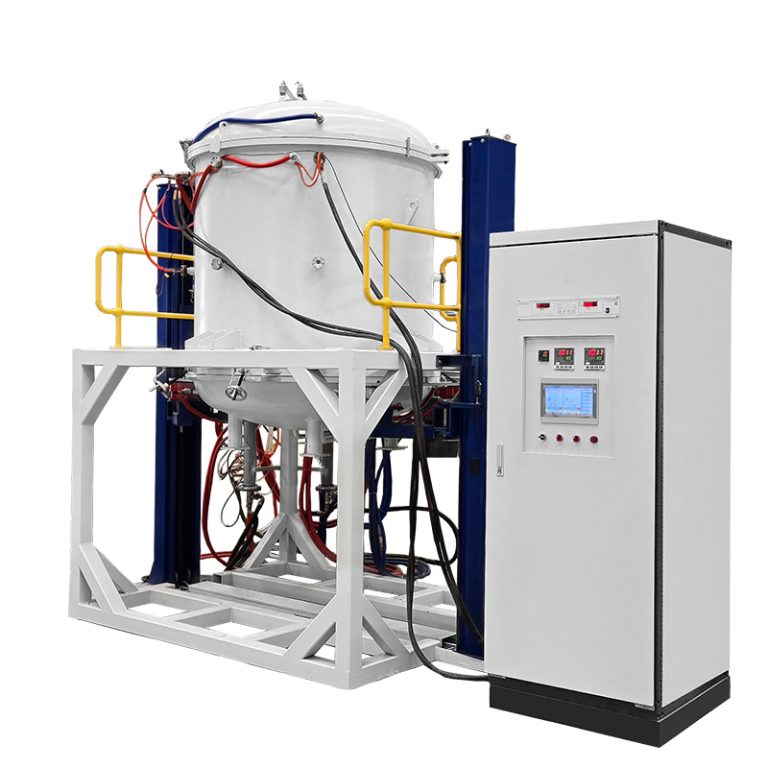
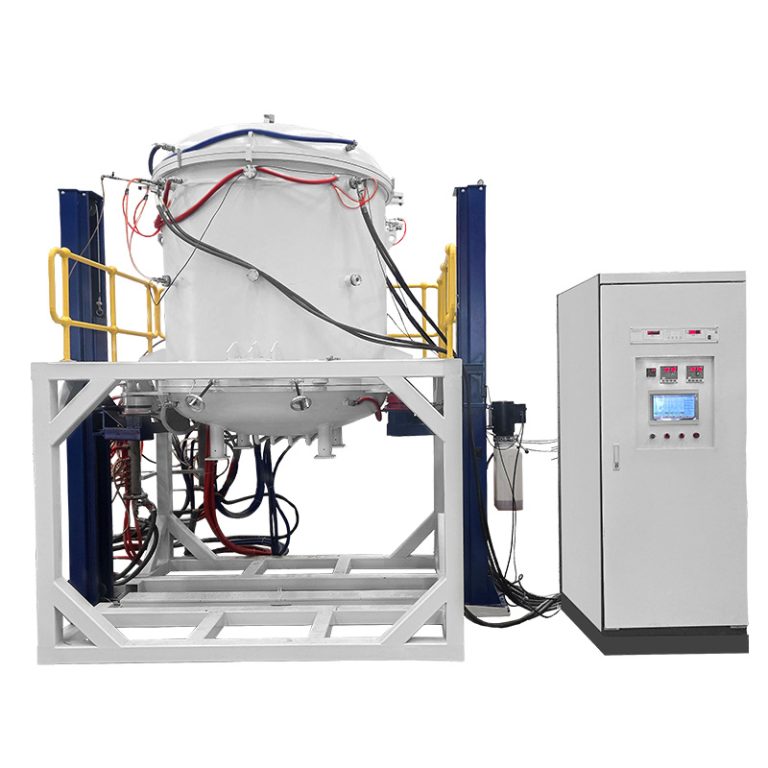
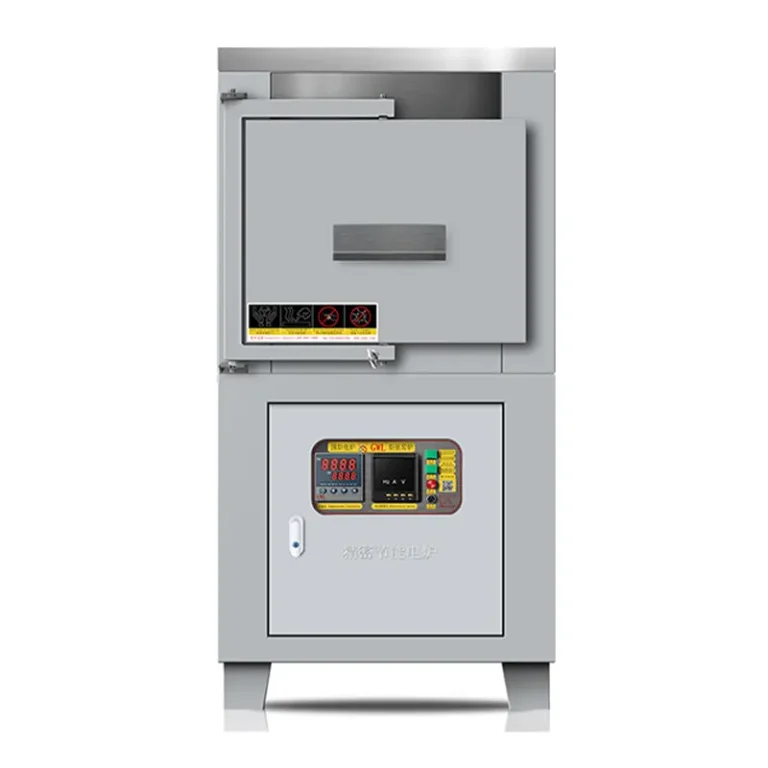
Luoyang Anjing Intelligence Equipment are a global leader in high-temperature electric furnaces



Roller Hearth Furnace vs Pusher Furnace: What’s the Difference?
A roller hearth furnace moves products through the heating chamber on driven rollers, while a pusher furnace uses a mechanical or hydraulic pusher to move workpieces or trays along fixed rails. Roller hearth furnaces offer greater conveying flexibility, while pusher furnaces provide a simpler, robust solution for repetitive high-volume production.
I.Introduction
When choosing a continuous industrial furnace, two common options are the roller hearth furnace and pusher furnace. Both can provide continuous, high-volume thermal processing, but they move products through the furnace in very different ways.
A roller hearth furnace uses a series of powered rollers to transport the load, while a pusher furnace mechanically pushes workpieces or trays through the heating zones. This difference affects product handling, cycle control, load capacity, maintenance, automation, furnace length, and investment cost.
Understanding these differences is important before selecting a furnace for heat treatment, sintering, annealing, normalizing, preheating, or other continuous high-temperature processes.
II.Roller Hearth Furnace vs Pusher Furnace: What Is the Main Difference?
The main difference is the material conveying system.
In a roller hearth furnace, heat-resistant rollers form the conveying surface. The rollers rotate and move the product or supporting tray continuously through the furnace.
In a pusher furnace, the hearth itself does not continuously move. A hydraulic, pneumatic, or electromechanical pusher advances the load through the furnace. Depending on the design, products can travel directly on rails or be carried on trays.
Both systems can divide the furnace into multiple temperature zones.
Both can be automated.
Both can be designed for high-volume production.
The question is not which technology is universally better, but which conveying method fits the product and production process.
1. Roller Hearth Furnace vs Pusher Furnace: Quick Comparison
| Factor | Roller Hearth Furnace | Pusher Furnace |
|---|---|---|
| Furnace type | Continuous | Continuous |
| Conveying method | Powered rollers | Mechanical/hydraulic pushing |
| Hearth movement | Rollers rotate | Hearth/rails remain fixed |
| Product movement | Individually conveyed or tray-based | Loads pushed sequentially |
| Speed control | Highly flexible | Based on pusher cycle |
| Residence time control | Easy to adjust through roller speed | Adjusted through pushing interval |
| Large/heavy parts | Excellent with proper roller design | Excellent for suitable loads |
| Long parts | Very suitable | Depends on product geometry |
| Tray requirement | Optional depending on product | Common, but not always required |
| Mechanical structure | More complex | Relatively simple |
| Roller maintenance | Required | Not required in conventional skid design |
| Pusher mechanism | Not required | Required |
| Initial investment | Generally higher | Generally lower for comparable simple systems |
| Automation potential | Excellent | Excellent |
| High-volume production | Excellent | Excellent |
| Process flexibility | Higher | More production-sequence dependent |
| Best fit | Flexible continuous processing | Stable repetitive production |
Actual performance depends on furnace temperature, atmosphere, workpiece geometry, load weight, throughput, and conveying-system design.
2. How Does a Roller Hearth Furnace Work?
A roller hearth furnace uses a row of heat-resistant rollers installed across the furnace chamber.
These rollers are driven from outside the furnace.
As they rotate, the workpiece or tray moves through different furnace sections, which may include:
Loading → Preheating → Heating → Soaking → Cooling → Unloading
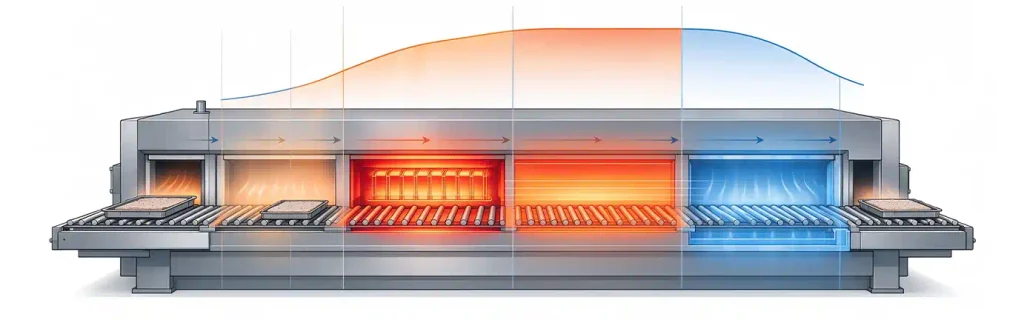
The roller speed determines how quickly the product moves through the furnace.
If the heated length is fixed, changing the conveying speed changes the approximate residence time inside each section.
This provides an important process advantage: transport speed can become part of the thermal recipe.
For example, if a product needs a longer soaking period, the line speed can be reduced within the allowable process range.
For higher throughput, the conveying speed may be increased if the heating process and furnace capacity permit it.
3. How Does a Pusher Furnace Work?
A pusher furnace uses a different movement principle.
Products are normally placed directly on suitable supports or loaded onto trays. A mechanical, hydraulic, or electromechanical pusher at the furnace entrance advances the load through the chamber.
A simplified sequence is:
New load enters → Pusher advances → Existing loads move forward → Finished load exits
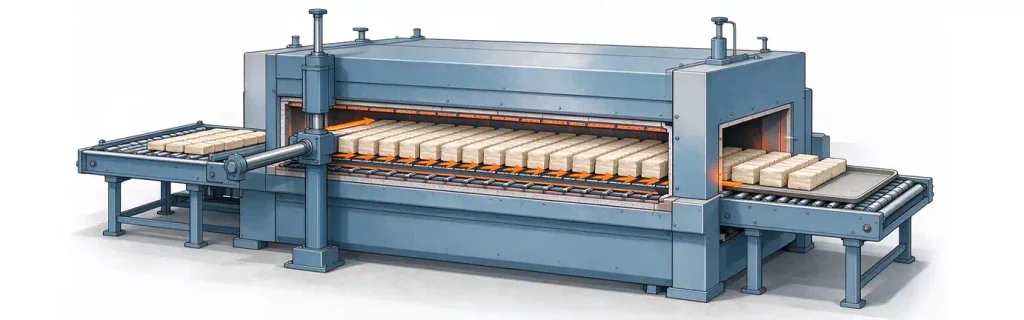
In a tray-based system, each new tray can push the line of trays ahead by one position.
This produces a step-by-step production flow.
The design is mechanically straightforward and has been widely used for industrial heat treatment, reheating, and sintering.
4. The Biggest Difference Is Product Movement
This is the first factor buyers should consider.
Roller Hearth Furnace
The load is supported and transported by rotating rollers.
This means movement does not depend on one load physically pushing the next load.
Individual loads can therefore be transported in a more controlled manner.
Depending on the furnace and drive design, roller control can also provide more flexibility in residence time and production sequencing.
Think:Roll the product through the furnace.
Pusher Furnace
A pusher applies force from the loading end.
The loads advance through the furnace along rails, skids, or another supporting structure.
In many designs, a new tray entering the furnace advances the trays already inside.
Think:Push the production queue through the furnace.
This simple mechanical distinction explains many of the differences between the two furnace types.
5. Which Furnace Offers Better Speed and Residence-Time Control?
A roller hearth furnace generally provides more flexible conveying control.
The speed of the rollers can be adjusted to change product travel time.
This is useful when:
- Different products use the same furnace.
- Heating times vary.
- Soaking requirements change.
- Production speed needs adjustment.
- Different sections require coordinated transport control.
Some advanced roller systems can divide the conveyor into independently controlled sections.
This provides more control over product movement than a conventional pusher line.
Pusher Furnace Residence Time
A pusher furnace controls production rhythm mainly through the pushing interval.
For example, if the pusher advances one tray every ten minutes, each load moves through the furnace according to that sequence.
This works very well when:
- Products are standardized.
- Batch/tray dimensions are consistent.
- Thermal cycles rarely change.
- Production runs continuously.
The limitation is that loads are more closely linked to the production queue.
Changing the residence time of one load independently is more difficult than in a more flexible roller conveying system.
Selection Rule
Variable residence time → Roller Hearth
Fixed repetitive cycle → Pusher
6. Workpiece Shape Matters
Product geometry can strongly influence the decision.
Roller Hearth Furnace
Roller hearth systems are particularly useful for products that can travel stably on rollers or trays.
Typical examples include:
- Plates
- Bars
- Tubes
- Pipes
- Large components
- Ceramic products
- Refractory products
- Battery materials
- Powder metallurgy products on trays
- Components requiring continuous heat treatment
Long products can be particularly suitable because the roller system provides multiple support points along the direction of travel.
Pusher Furnace
Pusher furnaces are well suited to products that can be arranged in stable trays or can move safely along the hearth.
Typical applications include:
- Billets
- Blocks
- Forgings
- Bearings
- Fasteners
- Sintered components
- Metal parts in trays
- Powder metallurgy products
- Ceramic products on setters
- Repetitive industrial loads
For irregular products, trays can create a standardized load format even when the individual components themselves are not easy to push directly.
7. Which Furnace Is More Flexible?
For changing production requirements, the roller hearth furnace generally offers greater conveying flexibility.
The roller speed can be controlled according to the process.
Depending on the design, different roller sections may also be controlled separately.
This can be valuable when the factory produces multiple products with different cycle requirements.
A pusher furnace is particularly efficient when the process is stable and repetitive.
Once the following parameters are standardized:
- Tray size
- Product weight
- Loading pattern
- Pushing interval
- Temperature zones
- Atmosphere
- Heating cycle
the line can operate continuously with excellent repeatability.
In Simple Terms:
More product/process variation → Roller Hearth Furnace
More standardized repetitive production → Pusher Furnace
8. Maintenance: Rollers vs Pusher Mechanism
Maintenance is an important practical difference.
Roller Hearth Furnace Maintenance
A roller hearth system contains many rotating components.
Maintenance may involve:
- Furnace rollers
- Bearings
- Roller shafts
- Drive chains
- Gearboxes
- Motors
- Couplings
- Seals
- Roller alignment
Rollers operate in or near a high-temperature environment, so their material selection and cooling or bearing arrangement are important.
Over time, rollers may require replacement.
The advantage is precise and flexible conveying.
The trade-off is a more complex transport system.
Pusher Furnace Maintenance
A conventional pusher furnace has a simpler internal transport structure.
Maintenance typically focuses on:
- Pusher mechanism
- Hydraulic system
- Pusher rod
- Skid rails
- Guide system
- Trays
- Refractory
- Drive components
The furnace does not require a long series of individually rotating hearth rollers.
This can simplify certain maintenance requirements.
However, trays and sliding surfaces are subject to high-temperature mechanical stress and wear.
Tray distortion can also become an operating issue in some heat-treatment applications.
9. Electric or Gas Heating?
Both roller hearth and pusher furnaces can be designed with different heat sources.
Depending on process requirements, options may include:
Electric Heating
Suitable when:
- Precise control is important.
- Clean heating is required.
- Electrical infrastructure is available.
- Local combustion emissions need to be avoided.
Gas Heating
Suitable when:
- Furnace capacity is large.
- Gas is economically available.
- High continuous heat input is required.
- The process permits combustion-based heating.
The decision between roller hearth and pusher should therefore be separated from the decision between electric and gas heating.
They answer two different engineering questions:
Roller vs Pusher = How does the product move?
Electric vs Gas = How is heat generated?
10. Controlled Atmosphere Applications
Both furnace types can also be designed for controlled-atmosphere processing.
Possible atmospheres depend on the process and furnace design and may include:
- Nitrogen
- Argon
- Endothermic gas
- Exothermic gas
- Hydrogen-containing atmospheres
- Other process-specific gases
For atmosphere applications, the conveying system must work together with:
- Entry seals
- Exit seals
- Gas curtains
- Purge chambers
- Atmosphere monitoring
- Pressure control
- Exhaust and safety systems
Therefore, if controlled atmosphere is required, it should be specified at the beginning of the furnace design.
It should not be treated as a simple accessory added after the furnace has been built.
11. When Should You Choose a Roller Hearth Furnace?
Choose a roller hearth furnace when the process requires:
- Continuous production
- Flexible conveying speed
- Adjustable residence time
- Long or large products
- Smooth product transport
- Multiple temperature zones
- High automation
- Integration with other production equipment
- Frequent production changes
- High throughput
A roller hearth design is particularly useful when the transport system needs to do more than simply move every load forward at the same fixed interval.
Typical Selection Logic
Continuous production + flexible movement + variable process → Roller Hearth Furnace
12. When Should You Choose a Pusher Furnace?
Choose a pusher furnace when the process requires:
- Continuous high-volume production
- Standardized products
- Standardized trays
- Repetitive thermal cycles
- Robust mechanical construction
- Simple conveying logic
- Stable production rhythm
- High load capacity
- Controlled-atmosphere processing where applicable
Pusher furnaces are especially attractive when every tray or product follows essentially the same process.
Typical Selection Logic
Continuous production + standardized load + repetitive process → Pusher Furnace
III. Which One Is Better?
Neither furnace is better for every application.
A roller hearth furnace usually provides greater conveying flexibility and process control. It is well suited to long products, large components, variable production, and applications where line speed needs to be adjusted precisely.
A pusher furnace provides a simpler movement principle and is highly effective for standardized products, tray-based loads, and repetitive high-volume production.
The final decision should be based on:
Product geometry + load weight + process temperature + residence time + atmosphere + hourly throughput + required flexibility
rather than furnace type alone.
IV. Conclusion
The main difference between a roller hearth furnace and a pusher furnace is the way products move through the heating chamber. A roller hearth furnace uses powered rollers, providing flexible conveying speed and controlled product movement. A pusher furnace uses a mechanical or hydraulic pusher to advance products or trays through the furnace in sequence.
Choose a roller hearth furnace when you need flexible residence time, smooth transport, long or large products, and a highly automated continuous line. Choose a pusher furnace when production is standardized, tray-based, repetitive, and better served by a simpler conveying concept.
If you are planning a continuous furnace line, provide your material, product dimensions, process temperature, thermal curve, atmosphere, tray size, and required hourly capacity. The furnace and conveying system can then be engineered around your actual production process.
Click “Request a Quote” to get a customized solution.
V. FAQ
1. What is the main difference between a roller hearth furnace and a pusher furnace?
A roller hearth furnace moves products through the furnace using powered heat-resistant rollers, while a pusher furnace uses a mechanical, hydraulic, or electromechanical pusher to move products or trays along fixed supports. Both are continuous furnace systems.
2. Is a roller hearth furnace better than a pusher furnace?
Not always. A roller hearth furnace generally provides more flexible conveying and residence-time control, while a pusher furnace offers a relatively simple and robust solution for standardized, repetitive production. The better choice depends on the product and process.
3. Which furnace is better for heavy loads?
Both can process heavy loads when properly engineered. Roller hearth furnaces require rollers, drives, and bearings sized for the load and operating temperature. Pusher furnaces require sufficient pusher force and suitable rails, skids, or trays. Workpiece geometry and total load weight should be evaluated before selection.
4. Which furnace requires more maintenance?
Roller-hearth furnaces involve numerous conveying components—rollers, bearings, shafts, drive systems, and gear reducers—all of which require maintenance. While the conveying mechanism in a pusher-type furnace is simpler, the pusher system, guide rails, trays, hydraulic components, and furnace lining still necessitate regular repair.
5. Can roller hearth and pusher furnaces use a controlled atmosphere?
Yes. Both furnace types can be engineered for controlled-atmosphere processing. The entry and exit sealing system, gas supply, atmosphere monitoring, furnace pressure, conveying system, and safety controls must all be designed for the selected process gas.
Supplier
Luoyang Anjing Intelligent Equipment Co., Ltd. is an enterprise dedicated to the research, development, production, sales, and technical services of heat treatment equipment such as high-temperature electric furnaces. We produce laboratory, vacuum, industrial, and medium frequency furnace, covering a temperature range from -100℃ to 2600℃, serving industries such as new energy, semiconductors, and advanced materials. We can provide customized solutions based on specific atmosphere, ultra-high temperature, and intelligent control system requirements. Please feel free to contact us if you are interested.