Luoyang Anjing Intelligence Equipment are a global leader in high-temperature electric furnaces



How to Cool an Intermediate Frequency Induction Furnace? Cooling Methods and System Guide
An intermediate frequency electric furnace is typically cooled by a closed-loop water-cooling system that circulates treated water through the induction coil, power supply, capacitors, water-cooled cables, and other heat-generating components before transferring the heat through a heat exchanger or closed cooling tower.
I. Introduction
How to cool an intermediate frequency electric furnace is an important question for safe melting and reliable furnace operation. An intermediate frequency induction furnace converts 50 Hz industrial-frequency AC into medium-frequency current, typically above 300 Hz and often into the kHz range, creating an alternating magnetic field in the induction coil to heat and melt metal. During this process, the induction coil, power supply, capacitors, water-cooled cables, and other high-current components generate substantial heat. A properly designed circulating water-cooling system transfers this heat away continuously and helps prevent overheating, equipment damage, and unplanned shutdowns.
How Does an Intermediate Frequency Electric Furnace Generate Heat?
An intermediate frequency electric furnace is an electromagnetic induction heating system.
Its basic working process is:
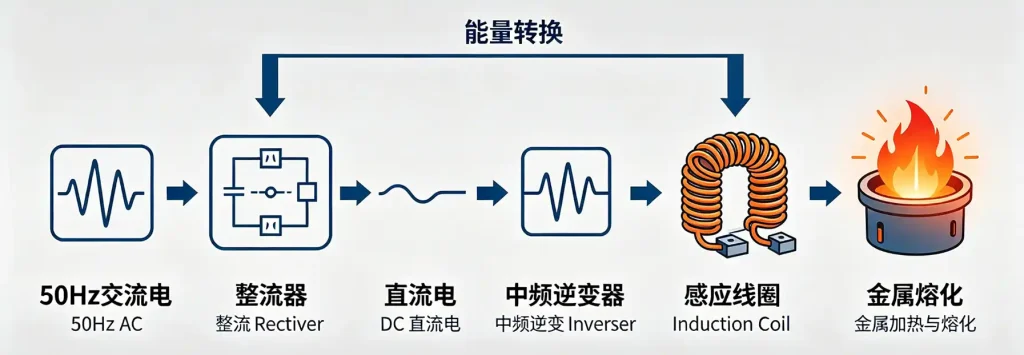
50 Hz AC power → rectification → DC power → medium-frequency AC → induction coil → electromagnetic induction → metal heating and melting
The medium-frequency current flows through the induction coil and generates a high-density alternating magnetic field. The magnetic field induces eddy currents inside the conductive metal charge, and the electrical resistance of the metal converts the induced electrical energy into heat.
The furnace therefore heats the metal without requiring a conventional flame or direct heating element.
However, not all electrical energy becomes useful heat in the metal. The induction coil, power electronics, capacitors, cables, busbars, and other components also generate heat. These components need continuous cooling during operation. Water cooling is commonly used because it can transfer heat efficiently while maintaining controlled operating temperatures.
Why Does an Intermediate Frequency Furnace Need Water Cooling?
The cooling system is not an optional accessory. It is a critical part of an intermediate frequency induction furnace.
During operation, high current flows through these components, producing resistive and switching losses that become heat.
Insufficient heat dissipation will cause the component temperature to exceed the standard, shorten the life, trigger protection, damage the insulation, and even cause equipment failure.
Therefore, the basic cooling principle is:
Heat generated by the furnace components → cooling water → heat exchanger/cooling tower → ambient air
II.Step-by-Step: How to Cool an Intermediate Frequency Electric Furnace
1.Identify All Components That Require Cooling
Do not assume that only the furnace coil needs cooling.
A complete system may require separate cooling circuits for:
- Induction coil
- Furnace body
- Intermediate-frequency power supply
- Capacitors
- Reactors
- Water-cooled cables
- Copper conductors
Different components can have different cooling requirements.
For example, the power supply may require cleaner or treated water than other parts of the system. Some furnace designs therefore use separate or isolated cooling circuits for the power electronics and furnace body.
2. Use a Continuous Circulating Water System
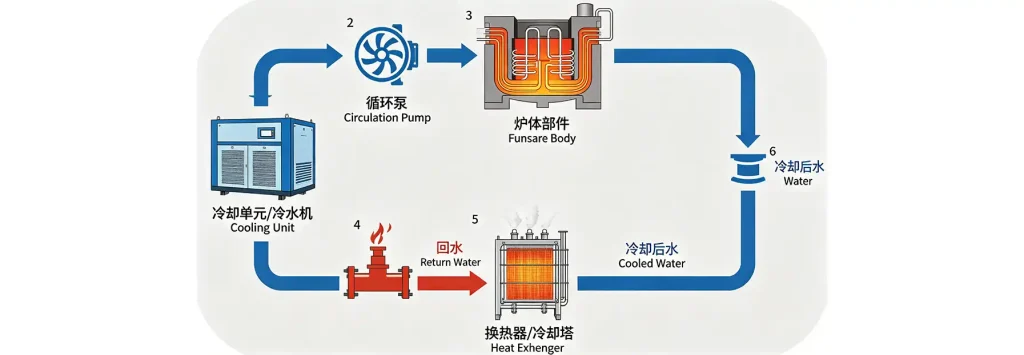
The basic cooling cycle is:
Cooling unit → circulation pump → furnace components → return water → heat exchanger/cooling tower → cooled water → furnace
The pump provides continuous water flow through the cooling circuits.
During furnace operation:
- The water enters the furnace cooling circuit.
- Heat is transferred from the hot component to the water.
- The heated water returns to the cooling unit.
- The heat exchanger or cooling tower removes the heat.
- The cooled water returns to the furnace.
- The cycle repeats.
This is much more suitable for continuous furnace operation than manually replacing hot water or relying on natural cooling.
3. Use a Closed Cooling Tower or Heat Exchanger
For industrial intermediate frequency furnaces, a closed cooling tower is one practical solution.
A closed system can separate the clean process water inside the furnace circuit from the external cooling environment. This helps reduce contamination, scale formation, and blockage within critical cooling passages.
A typical closed cooling tower works approximately as follows:
Hot process water → heat exchanger coil → heat transferred through the tube wall → air/spray-water cooling → cooled process water → furnace
The exact configuration should be selected according to furnace power, cooling load, operating hours, ambient conditions, and the manufacturer’s specifications.
4.Control Cooling-Water Temperature
Cooling-water temperature is a critical parameter.
Generally, for reference, publicly available cooling guidelines for medium-frequency furnaces indicate that the inlet water temperature for the induction coil and capacitor circuits should be approximately 20–35°C, and the outlet water temperature should be approximately below 55°C. Some systems have more stringent requirements for the capacitors, with the outlet water temperature recommended not to exceed 45–50°C.
The key principle is:
The cooling water must remain within the temperature range specified for the particular furnace and component.
Water that is excessively hot reduces the system’s ability to remove additional heat.
Water that is excessively cold can also create problems in some operating environments, including condensation on components when the surface temperature falls below the surrounding air’s dew point.
5.Maintain Adequate Water Pressure and Flow
Cooling performance depends on more than water temperature.
You also need sufficient:
- Water pressure
- Flow rate
- Pipe diameter
- Pump capacity
- Heat-exchanger capacity
Published guidance for some medium-frequency induction furnace systems specifies approximately 0.2–0.3 MPa for certain coil/capacitor cooling circuits, but this should not be treated as a universal specification. The correct pressure and flow must be based on the furnace manufacturer’s hydraulic design.
The important rule is:
Never increase or decrease water pressure blindly.
Too little flow can cause overheating.
Excessive pressure can stress hoses, fittings, seals, and cooling passages.
6.Use Proper Cooling Water
Cooling-water quality is one of the most frequently overlooked issues.
Poor-quality water can cause:
- Scale
- Corrosion
- Blocked cooling passages
- Reduced heat-transfer efficiency
- Pump problems
- Reduced component life
Some publicly available technical guidelines for medium-frequency furnaces recommend using treated or softened water and specify limits for parameters such as dissolved solids, conductivity, hardness, and pH. Specific values vary depending on the equipment design.
For this reason, do not simply connect an industrial furnace to untreated tap water without checking the manufacturer’s water-quality requirements.
A suitable cooling-water management program should monitor:
- pH
- Conductivity
- Hardness
- Dissolved solids
- Suspended solids
- Corrosion indicators
- Biological contamination where applicable
7.Install Water-Pressure and Flow Protection
A reliable intermediate frequency furnace cooling system should not depend on the operator noticing a problem after overheating has already occurred.
Install appropriate monitoring for:
- Water pressure
- Water flow
- Water inlet temperature
- Water outlet temperature
- Cooling-unit status
- Pump status
When a critical parameter falls outside the permitted range, the control system should generate an alarm and, where designed and approved by the furnace manufacturer, stop or inhibit furnace power.
Some intermediate-frequency furnace systems use pressure and temperature sensors, flow meters, alarms, and automatic power shutoff/interlock functions to protect the furnace from water shortage or excessive temperature.
8.Provide an Emergency Cooling System
This is especially important for high-power industrial furnaces.
A sudden loss of cooling water while the furnace is operating can rapidly create a dangerous condition.
A well-designed system may therefore include:
- Emergency water supply
- Backup circulation pump
- Emergency power supply
- Backup generator
- Municipal-water emergency connection where appropriate
- Automatic switching
- Water-pressure alarm
- Flow alarm
- High-temperature alarm
The exact emergency arrangement depends on furnace capacity and local safety requirements.
For high-capacity systems, the emergency cooling system should be designed before installation—not added after the first cooling failure.
III.Common Cooling Mistakes to Avoid
1.Using Ordinary Tap Water Without Checking Its Quality
This can lead to scaling, corrosion, and blockage.
Better approach: use the water treatment specified by the furnace manufacturer and monitor water quality regularly.
2.Cooling Only the Furnace Coil
The induction coil is important, but it is not necessarily the only heat-generating component.
Better approach: identify every water-cooled component, including the power supply, capacitors, cables, reactors, and other components.
3.Selecting a Cooling Tower Only by Furnace Tonnage
A 1-ton furnace and another 1-ton furnace may have very different electrical power and duty cycles.
Better approach: size the cooling system according to the actual heat load, power, operating schedule, ambient conditions, and manufacturer specifications.
4.Ignoring Water Flow
Cold water is not useful if the flow rate is insufficient.
Better approach: monitor both water temperature and flow.
5. Installing No Emergency Water Supply
A cooling-water interruption during melting can create a serious equipment and safety risk.
Better approach: evaluate backup water, emergency pumps, backup power, and automatic protection before commissioning.
6.Letting Cooling Water Become Too Cold
Excessively cold water can create condensation under certain ambient conditions.
Better approach: control water temperature within the manufacturer’s specified range rather than simply trying to make the water as cold as possible.
7.Ignoring Filters and Heat-Exchanger Maintenance
Even a well-designed cooling system can lose performance if filters become blocked or heat-transfer surfaces become fouled.
Better approach: establish a preventive-maintenance schedule for pumps, filters, heat exchangers, cooling towers, valves, sensors, and piping.
What Cooling System Does an Industrial Intermediate Frequency Furnace Need?
For an industrial intermediate frequency electric furnace, a complete cooling solution will generally include:
Cooling tower/heat exchanger + circulation pump + water tank/expansion system + filtration + cooling-water piping + temperature monitoring + pressure monitoring + flow monitoring + alarm/interlock + emergency cooling
The exact configuration depends on furnace capacity and design.
For example, some systems use separate circuits for the furnace/induction coil and the intermediate-frequency power supply because their cooling requirements can differ.
This is why a cooling system should ideally be specified together with the furnace rather than purchased as an unrelated auxiliary device.
Furnace Overheating — Troubleshooting and Handling Procedure (English)
| Step | Check Item | Specific Action / Judgment |
|---|---|---|
| 1 | Water Flow | Confirm the circulating pump is running; check for pipe blockages, closed valves, or pump failure |
| 2 | Water Pressure | Low pressure may indicate: pump failure, leakage, blockage, insufficient water, or valve issues |
| 3 | Inlet/Outlet Water Temperature | Excessive temperature difference may indicate changed heat load or insufficient flow |
| 4 | Cooling Tower or Heat Exchanger | Check fan operation, spray system, heat exchange surfaces, filter condition, and ambient airflow |
| 5 | Water Quality | Scale or contamination may restrict heat transfer |
| 6 | Manufacturer’s Shutdown Procedure | If cooling performance cannot be restored, immediately follow manufacturer’s emergency shutdown procedure to stop power output |
IV.Summarize
Cooling an intermediate frequency electric furnace requires more than simply circulating cold water around the furnace. A reliable system continuously transfers heat from the induction coil, power supply, capacitors, water-cooled cables, reactors, and other high-current components into a controlled water circuit, then rejects that heat through a heat exchanger or cooling tower. For industrial applications, a closed-loop cooling system with proper water treatment, temperature/pressure/flow monitoring, alarms, and emergency cooling can provide more stable and controllable operation.
If you are selecting an intermediate frequency furnace, do not size the cooling system by furnace capacity alone. Provide the furnace power, melting capacity, operating hours, cooling-water temperature, flow, pressure, and ambient conditions so the cooling system can be correctly matched to the furnace.
Click “Request a Quote” to get a customized solution.
V. FAQ
1. How do you cool an intermediate frequency electric furnace?
An intermediate frequency electric furnace is normally cooled with a forced circulating water system. Cooling water flows through the induction coil and other water-cooled components, absorbs heat, returns to a heat exchanger or cooling tower, releases the heat, and then circulates back to the furnace.
2. Why does an intermediate frequency induction furnace need water cooling?
The induction coil, power supply, capacitors, water-cooled cables, reactors, and other high-current components generate heat during operation. Continuous water cooling removes this heat and helps maintain the components within their permitted operating temperatures.
3. What type of cooling tower is best for an intermediate frequency furnace?
A closed cooling tower is often preferred for demanding industrial applications because it can keep the clean process-water circuit separated from the external environment, helping reduce contamination and deposits in critical cooling passages. The correct capacity depends on furnace power, heat load, duty cycle, ambient temperature, and required water conditions.
4. What temperature should the cooling water be for an intermediate frequency furnace?
The required temperature depends on the specific furnace and component. Some published guidance specifies approximately 20–35°C inlet water for certain coil and capacitor circuits and an outlet temperature below approximately 55°C, but these numbers should not be applied universally. Always use the temperature limits provided by the furnace manufacturer.
5. What happens if the cooling water stops during furnace operation?
A loss of cooling can cause the induction coil, power electronics, cables, or other components to overheat. A properly designed system should therefore have water-flow, pressure, and temperature monitoring, alarms, and appropriate power-interlock or emergency-shutdown functions.
Supplier
Luoyang Anjing Intelligent Equipment Co., Ltd. is an enterprise dedicated to the research, development, production, sales, and technical services of heat treatment equipment such as high-temperature electric furnaces. We produce laboratory, vacuum, industrial, and medium frequency furnace, covering a temperature range from -100℃ to 2600℃, serving industries such as new energy, semiconductors, and advanced materials. We can provide customized solutions based on specific atmosphere, ultra-high temperature, and intelligent control system requirements. Please feel free to contact us if you are interested.