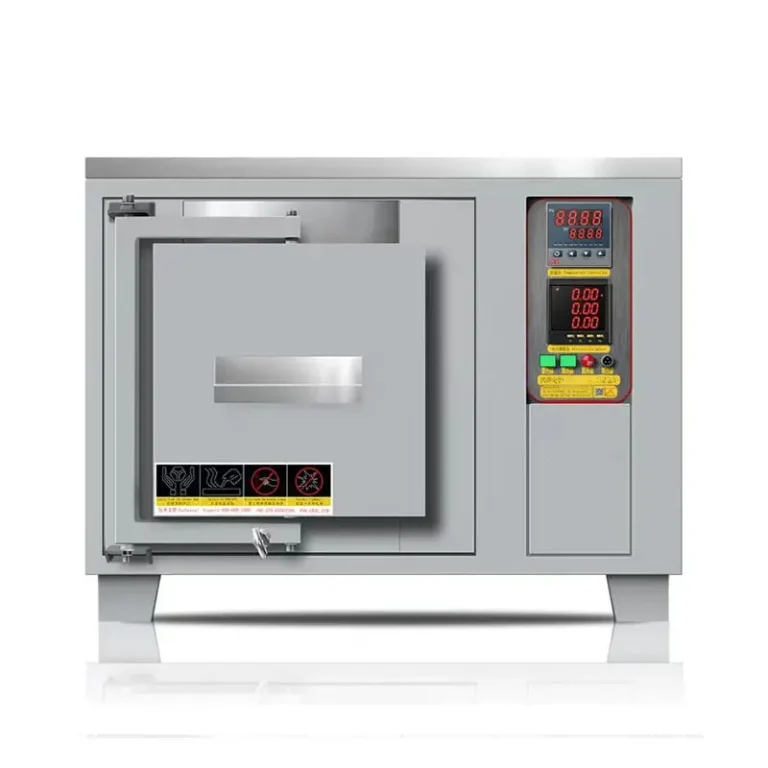
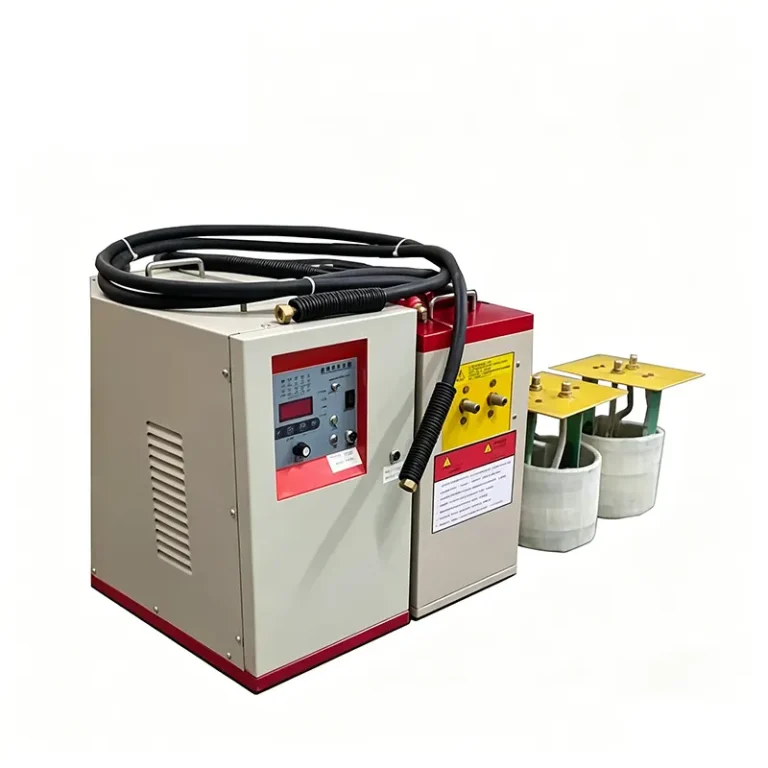
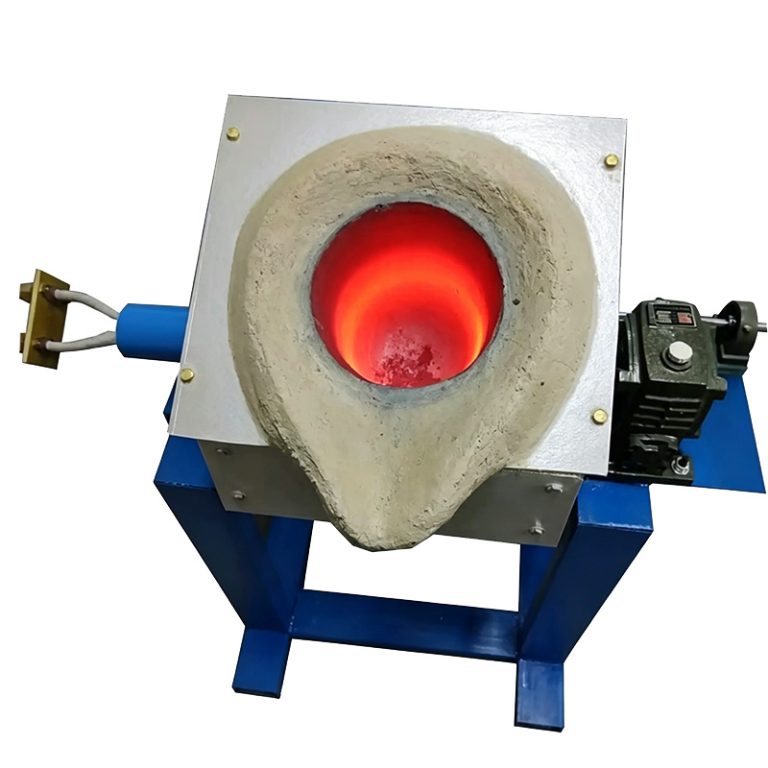
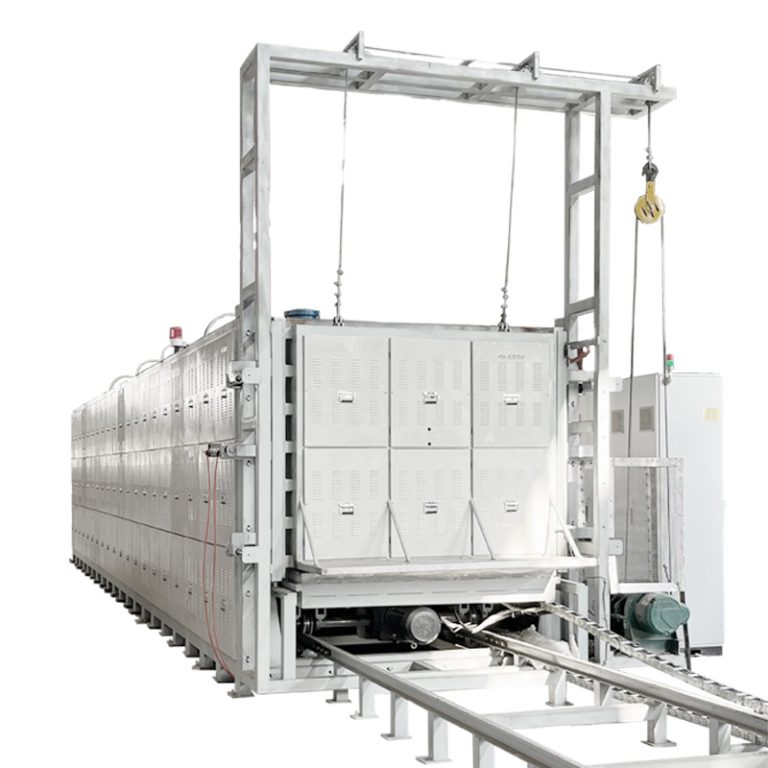
Luoyang Anjing Intelligence Equipment are a global leader in high-temperature electric furnaces



What Is a Tunnel Kiln? Working Principle and Industrial Applications
A tunnel kiln is a continuous industrial furnace that heats materials as they move through controlled temperature zones. It typically consists of preheating, firing, and cooling sections, allowing materials to undergo a defined thermal cycle without repeated batch heating and cooling. Tunnel kilns are widely used in ceramics, refractory materials, and advanced-material manufacturing.
I. Introduction
A tunnel kiln is a type of industrial heat-treatment equipment primarily used for continuous or sequential production. Unlike batch furnaces, it moves materials through a long, narrow heating channel using kiln cars, roller conveyors, or other transport systems.
With controllable material movement and zoned temperature control, tunnel kilns offer excellent stability for high-temperature processes like firing and sintering. The following sections outline the working principle, main structure, common types, and application areas of tunnel kilns, as well as key technical factors to consider when selecting one.
II. What Is a Tunnel Kiln?
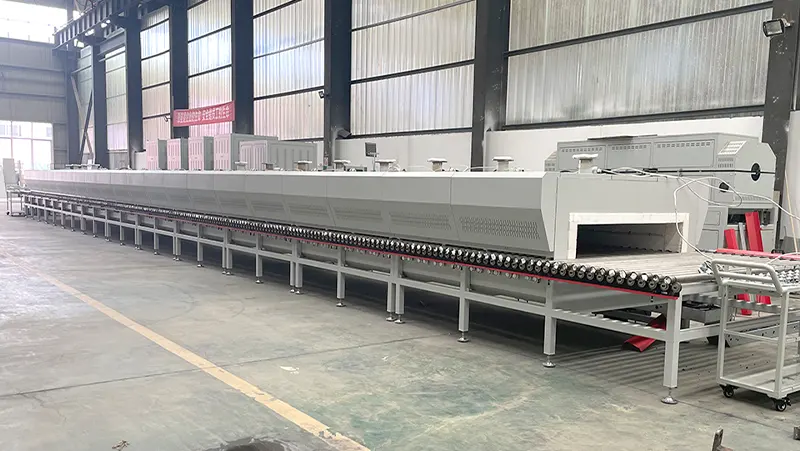
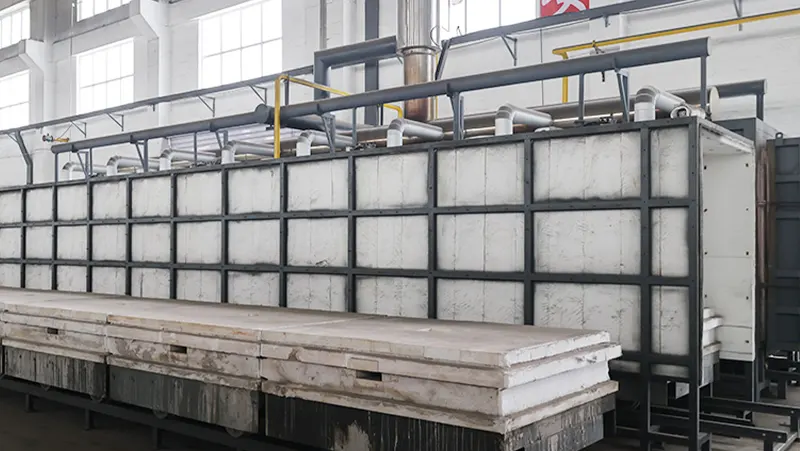
A tunnel kiln is a long industrial furnace designed to process materials as they travel through a series of controlled thermal zones.
The material enters at one end, moves through the furnace according to a specified production schedule, and exits at the other end after completing the required thermal process.
The basic process is:
Loading → Preheating → Firing or Sintering → Controlled Cooling → Unloading
The exact configuration depends on the material, processing temperature, production capacity, and required atmosphere.
Tunnel kilns are particularly suitable for manufacturing operations that require stable production, repeatable heating conditions, and a defined thermal cycle.
1.How Does a Tunnel Kiln Work?
The working principle of a tunnel kiln combines continuous material transportation with controlled heating, thermal holding, and cooling.
Instead of placing a batch inside a stationary furnace and waiting for the entire cycle to finish, the system moves materials through different temperature zones.
(1) Material Loading and Transportation
Products are loaded onto kiln cars, rollers, pusher plates, or another suitable conveying system.
The transportation method depends on the product’s size, weight, shape, and processing requirements.
For example, kiln cars are suitable for large or heavy loads that need substantial support, while roller hearth systems are designed for products or containers that can move safely on high-temperature rollers.
The conveying system determines how materials enter the furnace and how consistently they travel through the thermal zones.
(2)Preheating Zone
After entering the kiln, the material is gradually heated in the preheating zone.
This section helps reduce abrupt temperature changes and prepares the material for the higher-temperature processing stage.
Depending on the material, preheating may also help remove residual moisture or prepare the product for subsequent reactions.
The heating rate must be appropriate for the material because excessive thermal gradients can cause cracking, deformation, or other defects.
(3)Firing or Sintering Zone
The firing zone is the main high-temperature processing section.
Here, materials reach the temperature required for the intended process, such as ceramic firing, powder sintering, calcination, or other thermal treatment.
The required temperature depends on the material composition and process objective.
Independent temperature-control zones allow the furnace to establish a specific thermal profile along its length. This is particularly important when different products require carefully controlled heating rates and holding conditions.
(4)Cooling Zone
After the material completes the high-temperature stage, it enters the cooling zone.
Cooling must be controlled according to the material’s properties and production requirements.
For some ceramics, overly rapid cooling can create thermal stress and cracking. For other materials, the required cooling profile may be determined by phase transformations or dimensional-stability requirements.
A properly designed cooling zone helps the product reach the required discharge temperature before leaving the kiln.
(5) Continuous or Sequential Discharge
The processed material is removed at the discharge end while new material enters the feeding end.
Depending on the design, the material may move continuously or advance in controlled increments.
When the feeding rate, conveying speed, and temperature profile are properly coordinated, the kiln can maintain stable production over extended operating periods.
2.What Are the Main Types of Tunnel Kilns?
Tunnel kilns use different conveying systems according to the characteristics of the processed material.
(1)Kiln-Car Tunnel Kiln
A kiln-car tunnel kiln transports products on refractory-lined or otherwise suitable kiln cars that move along tracks through the furnace.
The cars carry the material through the preheating, firing, and cooling zones.
Typical applications include:
- Refractory bricks
- High-alumina products
- Magnesia-carbon bricks
- Clay bricks
- Heavy ceramic components
- Other large or heavy industrial products
Kiln-car systems are useful when products require a stable loading platform and sufficient load-bearing capacity.
Tunnel Kiln product category describes kiln-car transportation, independently controlled temperature zones, adjustable advancing speed, and configurations designed around different industrial processing requirements.
(2)Roller Hearth Tunnel Kiln
A roller hearth kiln transports materials through the furnace using a series of rotating rollers.
Products or material containers move along the rollers while passing through the heating zones.
Roller hearth designs are commonly used when the material can be supported and conveyed on rollers without compromising its geometry or process quality.
Typical applications include:
- Ceramic firing and sintering
- Electronic ceramic components
- Powder processing
- Metal product heat treatment
- Selected lithium battery material processes
- Continuous high-temperature processing
These features allow the thermal profile and material residence time to be coordinated with the production process.
(3) Pusher Plate Kiln
A pusher plate kiln transports material-loaded plates through the furnace using a mechanical or hydraulic pushing mechanism.
The plates advance through the successive thermal zones, allowing continuous or stepwise production.
Pusher plate kilns are particularly useful for standardized products that can be loaded onto compatible plates.
Common applications include:
- Advanced ceramics
- Electronic ceramics
- Powder metallurgy
- Magnetic materials
- Hard alloys
- Battery materials
- Catalyst processing
Important distinction: A kiln-car tunnel kiln, roller hearth kiln, and pusher plate kiln are related continuous furnace designs, but they use different conveying mechanisms. The correct choice depends on the actual product and production process.
3.What Are the Main Temperature Zones in a Tunnel Kiln?
Temperature zoning is central to tunnel kiln operation because materials need different thermal conditions at different stages.
Preheating Zone
- The preheating zone gradually raises the material temperature before the main processing stage.
- Its length and temperature profile depend on factors such as moisture content, material thickness, thermal properties, and the required heating rate.
Firing Zone
- The firing zone provides the temperature necessary for the intended thermal reaction.
- This may include ceramic firing, sintering, calcination, or other high-temperature processing.
- The temperature and holding conditions must be established through material-specific process development.
Cooling Zone
- The cooling zone controls the reduction in material temperature after firing.
- Its design should account for the risk of thermal stress, the required discharge temperature, production speed, and any material-specific cooling requirements.
- Not every tunnel kiln uses exactly three independently controlled sections. Industrial systems may divide the furnace into several smaller control zones to establish a more precise thermal profile.
4.Why Is Temperature Control Important in a Tunnel Kiln?
Temperature control directly influences product quality, consistency, and production stability.
Important parameters include:
- Maximum operating temperature
- Temperature uniformity
- Heating rate
- Holding temperature
- Residence time
- Cooling rate
- Temperature differences across the furnace width
- Atmosphere composition, where applicable
If the temperature varies excessively along or across the furnace, products may experience inconsistent sintering, firing defects, density variation, or dimensional changes.
For this reason, industrial tunnel kilns often use multiple independently controlled temperature zones and several temperature measurement points.
5.What Are the Advantages of a Tunnel Kiln?
(1)High Production Efficiency
Tunnel kilns are designed for continuous or sequential production.
Materials move through the furnace according to a defined operating cycle, reducing the need to stop the process for every batch.
This makes the equipment suitable for manufacturing operations with stable production demand.
(2) Consistent Product Quality
A controlled temperature profile helps products undergo repeatable heating, firing, and cooling conditions.
When the conveying speed, loading pattern, and temperature settings remain stable, the kiln can support consistent production quality.
(3)Reduced Repeated Heating of the Furnace Structure
Compared with some batch processes, continuous operation can reduce repeated heating and cooling of the furnace structure.
This can improve energy utilization in suitable production conditions.
However, actual energy consumption depends on insulation, loading rate, exhaust losses, thermal recovery, operating temperature, and production utilization.
(4)Easier Production-Line Integration
Tunnel kilns can be integrated with upstream and downstream equipment, including:
- Automatic loading systems
- Material conveyors
- Sorting and inspection stations
- Debinding systems
- Packaging or handling equipment
This can reduce manual handling and simplify production scheduling.
(5)Flexible Thermal-Profile Design
Multi-zone control allows manufacturers to adjust preheating, firing, and cooling conditions according to the product.
Depending on the system, the conveying speed can also be adjusted to change the material’s residence time.
6.What Industries Use Tunnel Kilns?
Tunnel kilns are used in several industrial sectors.
Ceramic Manufacturing
- Tunnel kilns can support continuous firing or sintering of industrial ceramics, construction ceramics, advanced ceramics, and selected ceramic components.
- The temperature profile depends on the ceramic formulation and the intended final properties.
Refractory Materials
- Refractory products often require controlled high-temperature treatment to develop their intended structure and performance.
- Tunnel kilns can be configured for products such as refractory bricks, high-alumina products, magnesia-carbon bricks, and other suitable refractory materials.
Electronic Ceramics
- Electronic ceramic manufacturing may require precise temperature control to achieve consistent electrical and mechanical properties.
- Depending on the production process, tunnel kilns can be used for sintering dielectric ceramics, piezoelectric ceramics, thermistor components, and other functional ceramic materials.
Powder Metallurgy
- Suitable tunnel kiln and pusher-kiln configurations can support continuous heat treatment or sintering of metal-powder components.
- Atmosphere requirements must be evaluated carefully when processing oxidation-sensitive materials.
Battery Materials
- Selected continuous kiln systems can be used for the thermal processing of battery-related materials.
- The appropriate furnace temperature, atmosphere, and material-handling system depend on the chemistry and processing requirements.
Advanced Materials and Catalysts
- Tunnel kilns and related continuous furnaces can also support calcination, activation, sintering, and other thermal processes for selected advanced materials and catalysts.
- Not every tunnel kiln is suitable for every application. Furnace structure, atmosphere, maximum temperature, residence time, and material compatibility must be considered together.
7.Tunnel Kiln vs. Batch Furnace: What Is the Difference?
| Feature | Tunnel Kiln | Batch Furnace |
|---|---|---|
| Production method | Continuous or sequential material movement | Fixed load processed by cycle |
| Material transportation | Kiln cars, rollers, or other mechanisms | Stationary load during the cycle |
| Production throughput | Suitable for stable, high-volume demand | Depends on batch size and cycle time |
| Temperature profile | Established along the furnace length | Established over time in one chamber |
| Automation | Well suited to production-line integration | Also available, depending on configuration |
| Product changeover | May require adjustments to the line and thermal profile | Often more flexible for varied products |
| Space requirement | Usually requires a long installation footprint | Often more compact for comparable small-batch applications |
| Typical application | Standardized, repeatable production | Flexible or intermittent production |
A tunnel kiln is generally most attractive when the manufacturer has a stable process and sufficient production volume.
For low-volume production, frequent product changes, or experiments involving many different thermal recipes, a batch furnace may provide greater flexibility.
III.Tunnel Kiln Solutions
MeltingFurnace.net offers tunnel kiln and related continuous furnace configurations for industrial thermal processing.
The tunnel kiln range describes systems with:
- Kiln-car transportation
- Multiple independently controlled temperature zones
- Adjustable material residence time
- Refractory, fiber, or lightweight kiln-car options
- Configurable maximum temperatures in the approximate 1200–1700°C range for the described kiln-car designs
These configurations are designed for applications such as refractory processing and other continuous high-temperature production processes.
For roller-conveyed production, the also offers a 1000°C continuous roller hearth kiln system with:
- A 22,000 mm-long furnace chamber
- Five temperature zones
- 20 temperature-control points
- Adjustable conveying speed
- A published temperature-control accuracy of ±1°C
The product is intended for continuous processing of suitable ceramics, powder materials, metal products, and other industrial materials.
The related Pusher Plate Kiln range is designed for continuous sintering and thermal processing of advanced ceramics, electronic ceramics, magnetic materials, powder metallurgy products, and selected battery materials.
Explore the relevant equipment pages:
For a customized project, the furnace configuration should be selected according to:
Material + Processing Temperature + Production Capacity + Conveying Method + Residence Time + Atmosphere + Cooling Requirements
This approach helps ensure that the kiln structure and control system match the actual manufacturing process.
IV. Conclusion
A tunnel kiln is an industrial furnace that moves materials through a controlled thermal process using kiln cars, rollers, or another suitable conveying mechanism. Its main operating zones typically include preheating, high-temperature firing or sintering, and cooling.
Tunnel kilns are widely used in ceramics, refractory manufacturing, electronic ceramics, powder metallurgy, and advanced-material processing. Their main advantages include high production throughput, repeatable thermal conditions, automated material handling, and integration with continuous manufacturing lines.
The right design depends on the material, processing temperature, production capacity, conveying method, residence time, atmosphere, and cooling requirements.
Contact MeltingFurnace.net to discuss your tunnel kiln requirements and select a furnace configuration matched to your material, production volume, temperature profile, and industrial process.
Click “Request a Quote” to get a customized solution.
V.FAQ
1.What is a tunnel kiln used for?
A tunnel kiln is used for continuous or sequential thermal processing of materials such as ceramics, refractory products, electronic ceramics, powder metallurgy components, and selected advanced materials. Typical processes include firing, sintering, calcination, and heat treatment, depending on the kiln design.
2.How does a tunnel kiln work?
Materials are fed into the kiln via kiln cars, roller conveyors, or other transport systems, passing sequentially through preheating, firing (or sintering), and cooling zones.
3.What is the difference between a tunnel kiln and a roller hearth kiln?
A tunnel kiln is a general type of elongated continuous furnace. A traditional kiln-car tunnel kiln transports products on cars moving along tracks, while a roller hearth kiln uses rotating rollers to convey suitable materials through the heating chamber. Both support continuous production, but their material-handling systems and product suitability differ.
4.What temperature can a tunnel kiln reach?
The operating temperature depends on the design and application. The tunnel kiln information published by describes customizable kiln-car configurations covering approximately 1200–1700°C, while the website also offers a separate 1000°C continuous roller hearth kiln. The appropriate rating should be selected according to the material and required process temperature.
5.What are the advantages of a tunnel kiln over a batch furnace?
In tunnel kilns, the material moves continuously or sequentially, ensuring a stable temperature profile and good repeatability; loading and unloading can be automated, allowing for high production output. Batch furnaces, however, are different; they offer greater flexibility when handling small batches, a wide variety of products, and frequent process changes.
Supplier
Luoyang Anjing Intelligent Equipment Co., Ltd. is an enterprise dedicated to the research, development, production, sales, and technical services of heat treatment equipment such as high-temperature electric furnaces. We produce laboratory, vacuum, industrial, and medium frequency furnace, covering a temperature range from -100℃ to 2600℃, serving industries such as new energy, semiconductors, and advanced materials. We can provide customized solutions based on specific atmosphere, ultra-high temperature, and intelligent control system requirements. Please feel free to contact us if you are interested.